
Common product, material and ordering questions.
Use these answers as a starting point, then contact AIF for project-specific product selection and quotation support.
What is the difference between the ASME RATED and Conventional lines?
ASME B16.5 flange code is written for one-piece flanges, while an insert flange is a two-piece flange. AIF's ASME RATED line uses engineered thicknesses that are slightly greater in some sizes so the insert flange meets the applicable pressure-temperature ratings of the corresponding weight class. The Conventional line uses standard flange thicknesses. AIF recommends the ASME RATED line for new applications and continues to offer the Conventional line for existing systems that require it.
Is there a patent or single-company right on insert flanges?
No. Insert flanges are derived from standard flange concepts and have been supplied by multiple companies over many decades. AIF focuses on its own insert flange product line, technical support and custom capability.
Do insert flanges conform to the requirements of ASME B31.3?
AIF states that insert flanges can be designed in accordance with the flange design provisions referenced by ASME B31.3. Project requirements, materials and service conditions should be reviewed as part of the specification and quotation process.
What materials are available?
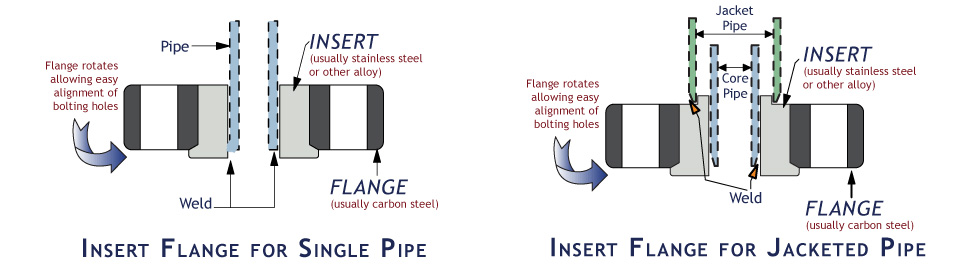
The insert is usually 316/316L or 304/304L stainless steel. The flange is usually A-105 or Pressure Vessel quality 515/516 Grade 70 carbon steel. AIF also works with Alloy 20, Duplex Alloys, Nickel Alloys and Hastelloy grades including C276, C22 and B-3 and Aluminum.
Is all material domestic?
AIF can quote domestic material when required and may also offer foreign material when project needs or pricing call for another option. State any domestic-material requirement at the time of quotation.
Does AIF manufacture custom flanges or provide machining?
Yes. Custom flange work and CNC machining are part of AIF's capabilities in addition to the standard insert flange product line.
What information should I provide for a single-piping quotation?
Provide the series if known, or the size, connection style, pressure class and materials. Quantity and any project-specific requirements should also be included.
What information should I provide for a jacketed-piping quotation?
Provide the series if known, or the flange size, core-pipe size, jacket-pipe size, process connection style, pipe schedules, materials and quantity.
What do reducing and non-reducing mean for jacketed piping?
The terms describe the relationship between the nominal flange size and the core-pipe size. Oversize or reducing configurations use a flange size larger than the core pipe. Line-size or non-reducing configurations use a flange size that corresponds to the core-pipe size.
Does AIF sell outside the United States?
Yes. American Insert Flange states that it supplies flange products to customers around the world.